> For the complete documentation index, see [llms.txt](https://docs.trustlesswork.com/trustless-work/llms.txt). Markdown versions of documentation pages are available by appending `.md` to page URLs; this page is available as [Markdown](https://docs.trustlesswork.com/trustless-work/v2-en/use-cases-by-indutry/marketplaces-and-e-commerce.md).
# Marketplaces & E-commerce
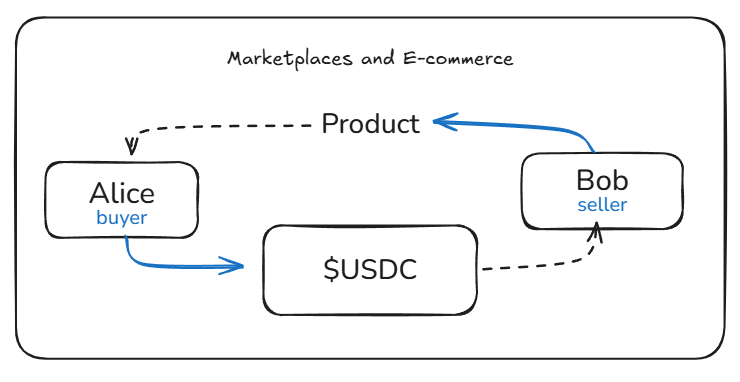
Trust is the foundation of every marketplace transaction—but building that trust usually means building complex infrastructure. Traditional platforms like eBay, Etsy, and Amazon use internal escrow mechanisms to ensure that sellers are paid **only** after buyers are satisfied. Most startups and emerging platforms can’t afford to build this kind of system.
**Trustless Work** makes it easy for any marketplace or e-commerce platform to integrate neutral, transparent escrow flows using stablecoins—without needing to manage custody, compliance, or custom infrastructure.
With just a few API calls, funds can be held securely until the product is shipped, received, or approved—ensuring fairness for both buyers and sellers.
***
### Core Use Cases
#### 1. Product Delivery Assurance
Hold payment in escrow when an order is placed. Release it only after the buyer confirms receipt, or automatically after a timeout.
#### 2. Dropshipping & Cross-Border Sales
Funds stay in escrow until the seller provides valid shipping proof (e.g. tracking number). Great for low-trust environments and international trade.
#### 3. Digital Goods & Downloads
For assets like templates, code snippets, plugins, or in-game items. Funds are released after the buyer confirms access or download is complete.
#### 4. Second-Hand & P2P Goods
Buyers escrow payment when purchasing from another user. Once the item is received or confirmed, funds are released to the seller.
***
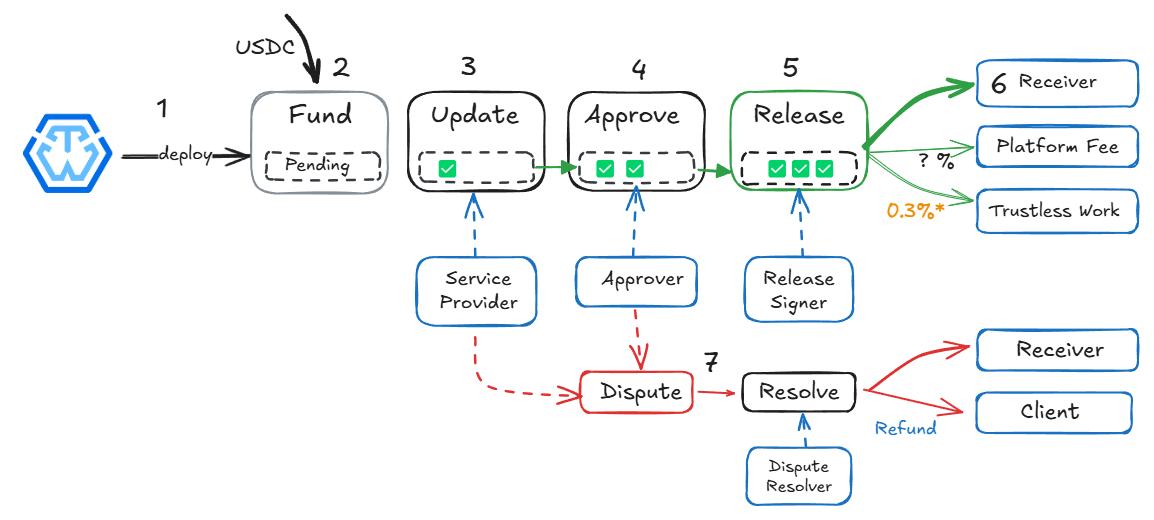
### Escrow Flow for Marketplaces
1. **Initiation Phase**\
The buyer places an order. A new escrow contract is created, defining the roles:
* **Buyer** funds the escrow
* **Seller** delivers the item
* **Buyer** or **Platform** signs for release
2. **Funding Phase**\
The buyer deposits stablecoins (e.g. USDC, EURC) into the escrow.
3. **Milestone Status Update Phase**\
The seller marks the item as shipped or provides tracking information.
4. **Approval Phase**\
The buyer confirms delivery or the system auto-approves after a timeout. If approved, funds move to release.
5. **Release Phase**\
The escrow releases the funds to the seller. Optionally, a platform fee is deducted.
6. **Receiver** - Receives the funds from Escrow
7. **Dispute Resolution (optional)**\
If the buyer disputes the delivery, a platform moderator or external resolver can step in, depending on the escrow configuration.
***
### Benefits for Marketplaces
* **Fast Integration** – Plug-and-play escrow API and UI templates
* **Global Payments** – Accept and settle in stablecoins (e.g. USDC) across borders
* **Reduce Fraud & Chargebacks** – Escrow eliminates the need for trust in the transaction
* **Neutrality by Design** – Funds are not held by the platform, but by a smart contract
* **Custom Logic** – Choose who approves release: buyer, platform, or auto-timer
***
### Who Should Use This
* Web3 marketplaces (NFTs, gaming items, digital goods)
* Niche e-commerce platforms with physical or digital products
* Second-hand or peer-to-peer selling apps
* Dropshipping or global e-commerce platforms
* No-code marketplaces using stablecoins
---
# Agent Instructions
This documentation is published with GitBook. GitBook is the documentation platform designed so that both humans and AI agents can read, navigate, and reason over technical content effectively. Learn more at gitbook.com.
## Querying This Documentation
If you need additional information that is not directly available in this page, you can query the documentation by asking a question.
Perform an HTTP GET request on the following URL with the `ask` and `goal` query parameters:
```
GET https://docs.trustlesswork.com/trustless-work/v2-en/use-cases-by-indutry/marketplaces-and-e-commerce.md?ask=&goal=
```
`ask` is the immediate question: it should be specific, self-contained, and written in natural language.
`goal` is what the user is ultimately trying to achieve, the reason they need the answer. Sharing it helps GitBook give you a better, more relevant answer. A goal is most helpful when it describes the outcome the user wants rather than restating the question. For example, with `ask=how do I create an API token`, a goal like `automate deployments from our CI pipeline` lets GitBook tailor the answer to that use case.
The response will contain a direct answer to the question and relevant excerpts and sources from the documentation.
Use this mechanism when the answer is not explicitly present in the current page, you need clarification or additional context, or you want to retrieve related documentation sections.