> For the complete documentation index, see [llms.txt](https://docs.trustlesswork.com/trustless-work/llms.txt). Markdown versions of documentation pages are available by appending `.md` to page URLs; this page is available as [Markdown](https://docs.trustlesswork.com/trustless-work/introduction/readme/why-escrows-matter.md).
# Why Escrows Matter
Escrow is a neutral way to hold funds until conditions are met. It’s the simplest primitive for “trust, but verify”.
### Escrow is the trust layer
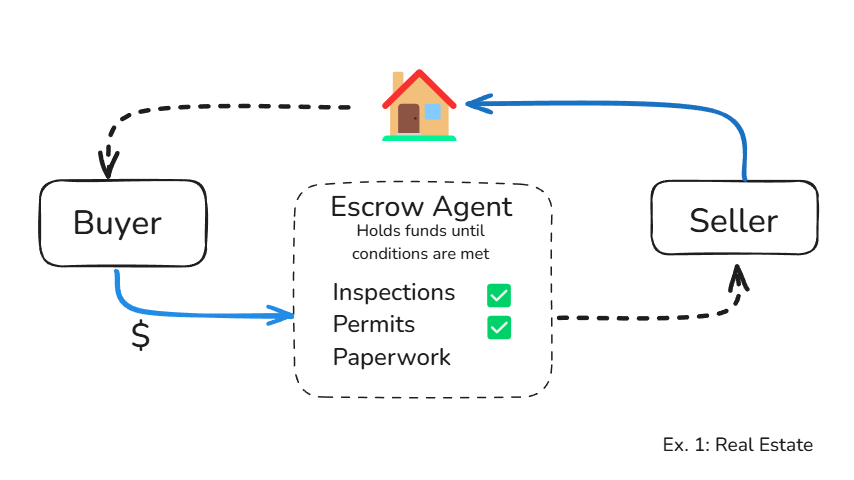
Most people first think of real estate. That’s correct. Escrow is common in high-value transactions.
Simple representation of a Real Estate Escrow.
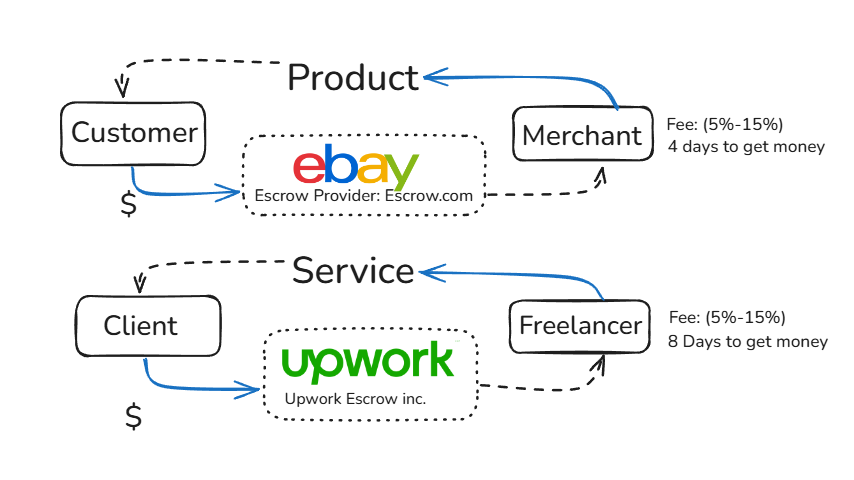
Escrow also shows up in marketplaces (Upwork, eBay, etc.).
Escrows on digital marketplaces.
Big platforms can afford escrow infrastructure. Many others can’t.
eBay leans on legacy providers (often 3%–8% fees). Upwork invested heavily in escrow operations.
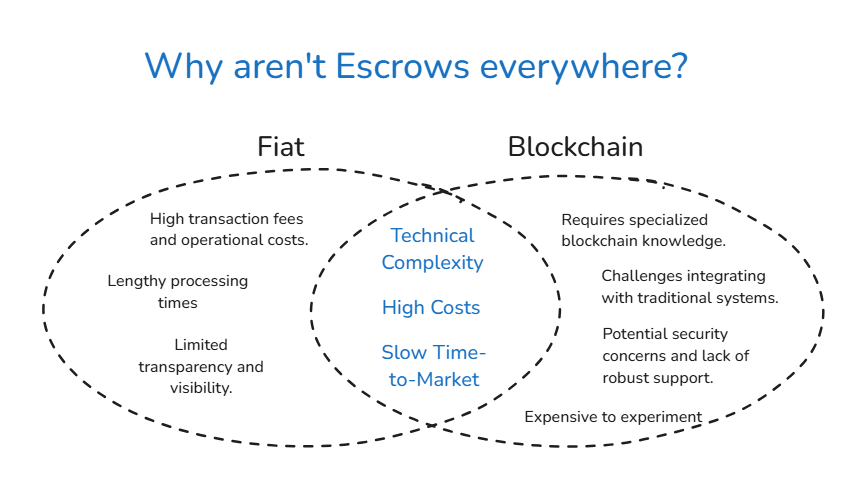
Platforms that could greatly benefit from the use of escrows don't use them because of the technical complexity and cost of building an escrow infrastructure.
### Why legacy escrow is hard
* **Fiat escrow is expensive and slow.** It typically requires bank rails and settlement workflows.
* **It’s operationally heavy.** Real estate, M\&A, and cross-border trade use escrow because they can justify the overhead.
{% hint style="warning" %}
Some teams spend months to a year building escrow infrastructure.
{% endhint %}
### Why smart-contract escrow wins (but still hurts to build)
Blockchain makes escrow programmable and auditable. But building production-grade contracts and flows still takes specialized time. Most teams don’t want to hire a full smart contract team for v1.
### What escrow solves
* **Chargebacks** and fraud in marketplaces
* **Late or withheld payments** for freelancers
* **Unclear fund control** in grants, bounties, or pre-orders
* **No dispute path** in P2P or milestone deals
### What Trustless Escrow enables
* Payments release only when work is approved.
* Funds sit in secure, neutral smart contracts.
* Approval flows can be signed by users, platforms, or agents.
* Works globally with USDC and Stellar settlement.
### Next steps
* Get started: [Developer Quickstart](broken://spaces/Dg2e2YCRmNlhCnxxmEb6/pages/bknsGrFeT0G5xw1ebl4u)
---
# Agent Instructions
This documentation is published with GitBook. GitBook is the documentation platform designed so that both humans and AI agents can read, navigate, and reason over technical content effectively. Learn more at gitbook.com.
## Querying This Documentation
If you need additional information that is not directly available in this page, you can query the documentation by asking a question.
Perform an HTTP GET request on the following URL with the `ask` and `goal` query parameters:
```
GET https://docs.trustlesswork.com/trustless-work/introduction/readme/why-escrows-matter.md?ask=&goal=
```
`ask` is the immediate question: it should be specific, self-contained, and written in natural language.
`goal` is what the user is ultimately trying to achieve, the reason they need the answer. Sharing it helps GitBook give you a better, more relevant answer. A goal is most helpful when it describes the outcome the user wants rather than restating the question. For example, with `ask=how do I create an API token`, a goal like `automate deployments from our CI pipeline` lets GitBook tailor the answer to that use case.
The response will contain a direct answer to the question and relevant excerpts and sources from the documentation.
Use this mechanism when the answer is not explicitly present in the current page, you need clarification or additional context, or you want to retrieve related documentation sections.